The golden, bandage-like organs covering its body are highly elastic. However, they are prone to tearing under extremely dry conditions, so daily moisture checks are absolutely essential.
Capture locations
Where to find Gildra
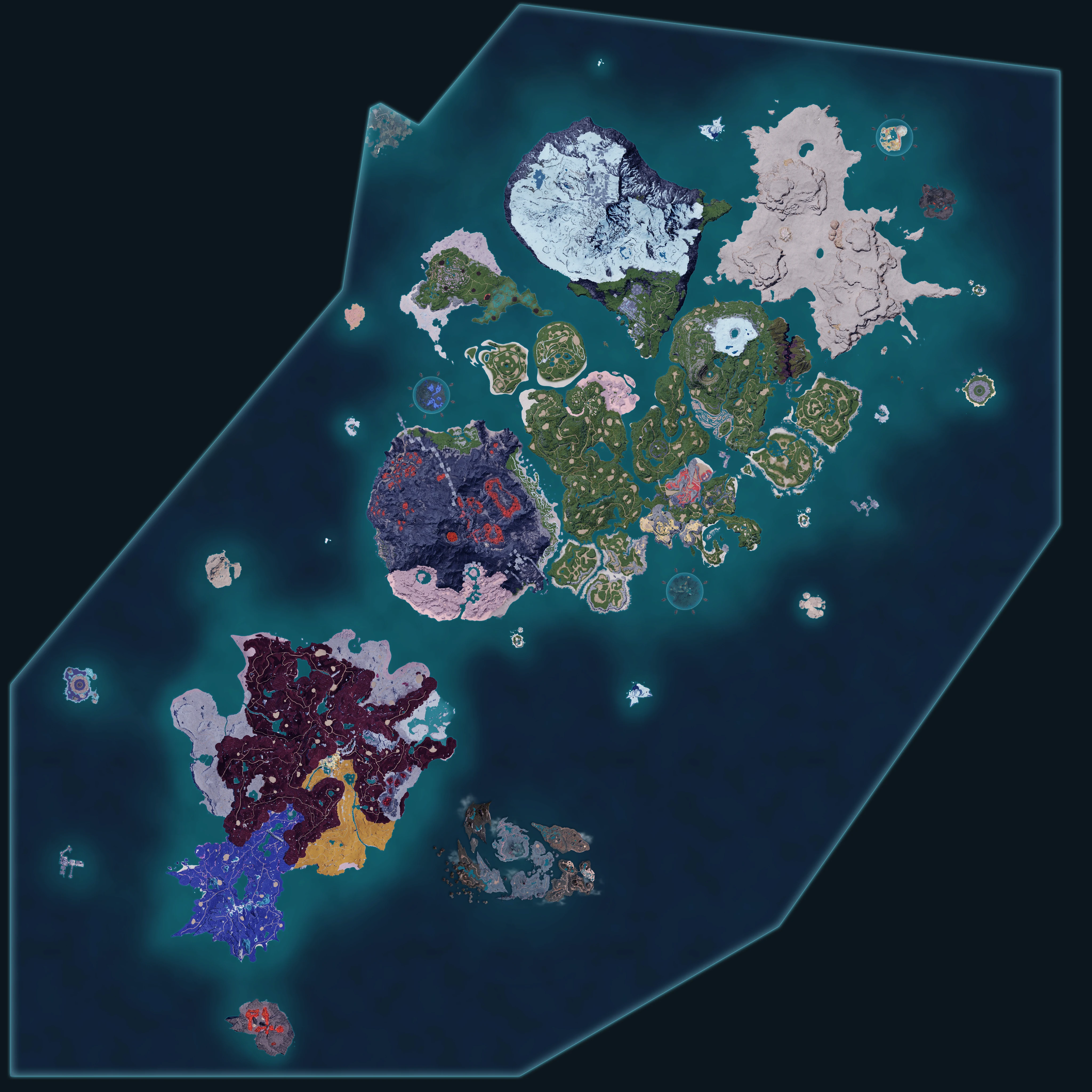
Wild and Alpha markers show where this Pal appears, with its level range, group size, and active time for each spawn pattern.
All 346 mapped locations are represented. Dense nearby points are grouped into 139 readable markers; open the full map to zoom into every individual position.
How to get Gildra
The current map snapshot contains 346 wild or Alpha positions for this entry. Open the map above for spawn levels, group sizes, worlds, and active time; use the breeding guide for alternate routes.
Mapped positions
346
Other-species pairs
190
The breeding graph contains 191 parent pairs including the same-species result. Open the guide to inspect every pair; “recommended” is a site convenience, not an official game ranking.
Is Gildra worth using? Strengths, trade-offs, and breeding value
Gildra is a Dark and Ground entry with 105 base HP, 120 ranged attack, and 105 defense. Read together, those values make Ranged attack its clearest statistical feature, currently in the upper quartile of the verified roster. The analysis below combines the raw profile with 3 work roles, 346 mapped encounter points, and 190 mixed-species parent combinations. It is a practical interpretation of the current data rather than an official tier, a promise about one individual Pal, or text copied from the Paldeck.
HP
105middle range
Current roster median: 95
Ranged attack
120upper quartile
Current roster median: 95
Defense
105upper quartile
Current roster median: 90
Combat profile and real trade-offs
Gildra has the shape of an offense-first species. Its 120 ranged attack sits in the upper quartile, while 105 HP and 105 defense show how much room there is for mistakes once an enemy reaches it. The weakest of the three headline values is HP at 105, so a sensible team plan is to let a sturdier Pal hold attention while Gildra contributes damage. This is not a complete damage ranking: active-skill power, cooldowns, partner skills, elemental matchups, passives, souls, talents, level, and player equipment can all reverse a base-stat comparison.
The Dark and Ground typing tells you which elemental identity to investigate, but this page deliberately does not infer a final matchup chart or damage rotation from typing alone. Gildra also has 100 configured stamina and 100 support, two useful context values that should not be mistaken for direct DPS. Before spending rare souls or a long passive-breeding chain, compare the active skills and partner-skill effect in your current game version, then use these extracted base numbers as the stable foundation for that decision.
Best base role and staffing plan
At a base, Gildra can perform Handiwork Lv. 5, Medicine Production Lv. 4, and Transporting Lv. 2. Its highest listed assignment is Handiwork at level 5, across 3 total job types. That makes the top role the first place to test it, while the lower-level roles may be useful backup or may cause unwanted task switching depending on your base layout. A food need of 6 and configured transport speed of 350 add operating context, but neither number proves hourly output by itself. Put the Pal near the station you actually want staffed, watch for pathing and breaks, and compare completed work over a real production cycle before replacing a focused worker.
Acquisition plan: capture first or breed first?
The verified map snapshot contains 346 encounter points for Gildra: 346 wild and 0 Alpha positions across 2 mapped world section(s). Its profile is marked nocturnal for nocturnal behavior. Use the map to compare level ranges, group sizes, and active times rather than choosing the nearest marker blindly; a direct capture can save several Cakes when you only need the species, while breeding can be better when parent passives or a controlled lineage matter. Mapped points describe the current dataset, not a guarantee that every event, dungeon, raid, merchant, or patch-specific acquisition route is represented.
Breeding flexibility and lineage planning
Gildra has 190 mixed-species combinations using 195 distinct parent species in the audited graph. A practical first pair to inspect is Univolt Cryst + Elizabee; it is surfaced by a low combined Paldeck-number heuristic, not by a claim that those parents have the easiest spawns or best passives. The species breeding-power value is 1170, which helps resolve formula results but is not a combat score. Its configured sex split is 50% male and 50% female (close to balanced), so repeat hatches may be needed before a same-species line has the genders you want. Choose the direct pair already closest to your Palbox and passive goal, then move to same-species breeding once the target line is established.
Practical verdict for Gildra
The best reason to invest in Gildra is a plan that actually uses its strongest measured feature—Ranged attack at 120—or its leading base role, Handiwork Lv. 5. The page records 346 mapped encounter points and 190 mixed breeding routes, so acquisition flexibility should be weighed alongside combat and work value. A Pal with excellent numbers can still be the wrong project when its role duplicates a finished team member; a modest profile can be worthwhile when it fills a missing element, job, passive pipeline, or Paldeck objective. Decide on one purpose first, then evaluate the individual hatch or capture against that purpose.
•Compare Gildra's base values with the role you need; do not treat one number as a complete tier placement.
•For base use, test Gildra at the intended station and watch pathing, food, breaks, and unwanted task switching.
•For acquisition, compare the mapped level and time rules with the number of breeding steps and Cakes your save would require.
•For a long-term line, secure the target species first, then optimize gender, passives, talents, active skills, and Mutation separately.
Method note: quartile labels use all 299 profiles in the site dataset verified on August 5, 2026. They compare unmodified species values only. The interpretation is written from those values, mapped spawn evidence, work rows, and the current breeding graph; it does not claim hidden play-test results or replace current patch notes.
Complete attributes
Combat and utility overview
Species base values before level scaling, passives, souls, equipment, or player-side bonuses.
HP
105
Ranged attack
120
Melee attack
100
Defense
105
Support
100
Stamina
100
Rarity
5
Craft speed
100
Work suitability
Every base job this species can perform, with the original integer level from the extracted game data.
HandiworkLv. 5
Medicine productionLv. 4
TransportingLv. 2
Capture and survival
Catch difficulty, hunger, experience yield, and trap compatibility.
Size class
M
Catch-rate factor
1×
Food need
6
Hunger capacity
450
Hunger drain rate
1×
EXP yield
1×
Hanging Trap eligible
No
Breeding and behavior
Breeding power, sex ratio, value, and species behavior flags.
Base sale value
2,529
Male probability
50%
Breeding power
1170
Nocturnal
Yes
Predator
No
Edible
Yes
Movement speeds
All configured ground, riding, transport, and swimming speeds.
Slow walk
75
Walk
150
Run
480
Ride sprint
720
Transport
350
Swim
144
Swim dash
216
Enemy encounter modifiers
How this character entry scales when encountered as an enemy. A value of 1× means no modifier.
Status resistance
1×
Enemy HP
1×
Damage received
1×
Damage dealt
1×
Skill cooldown
1×
Flinch immunity
No
Knockback immunity
No
Stun immunity
No
Breed and plan with Gildra
Explore every parent combination, send this Pal to the calculator, or build a complete breeding route.